

The offsite solution
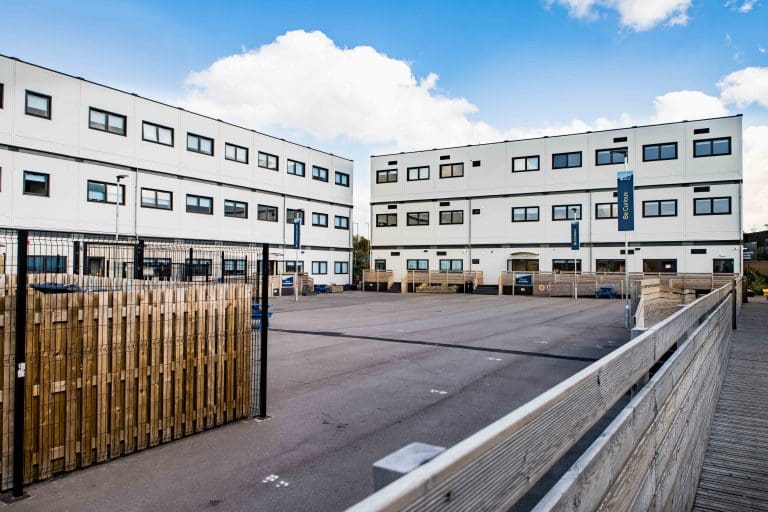
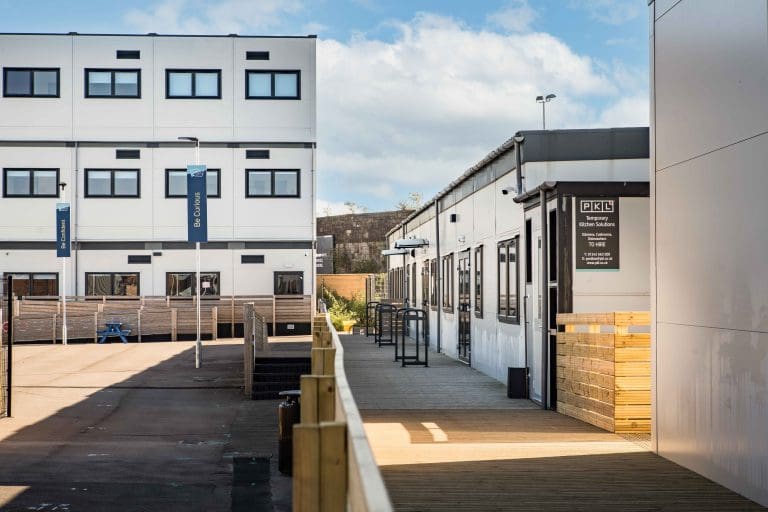
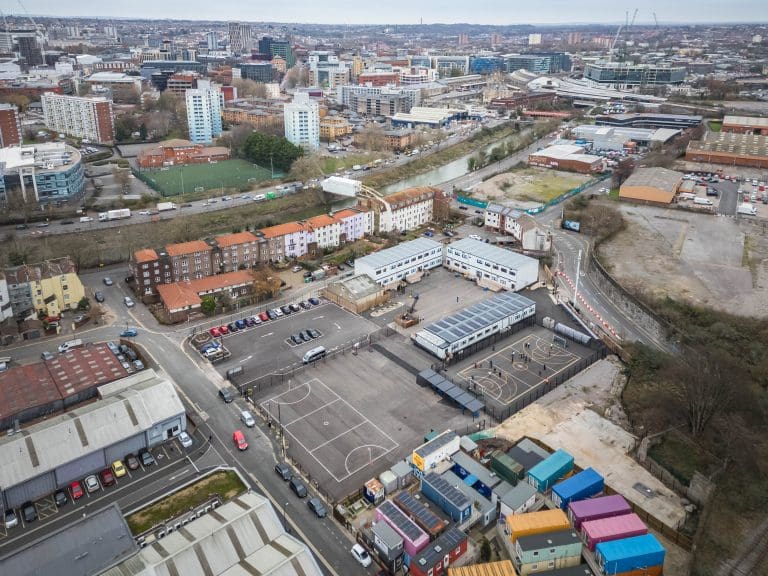
The school has benefitted from built-in flexibility, with the third storey and a new single-storey dining area extension successfully installed over the summer holiday period, providing high-quality teaching and social spaces without disruption to learning. The design also allows for further expansion in the future, with the potential for additional accommodation to be added next year to support the continued growth of the school community.
Following the completion of the permanent Oasis Academy Temple Quarter school, the temporary school will be removed and repurposed by McAvoy and the site will be restored to its original condition, contributing to Bristol City Council’s visionary redevelopment plans for the area.
SmartClass(R) adaptability
A key success factor at Oasis Academy Temple Quarter has been the flexibility of McAvoy’s SmartClass® rental solution. Designed for phased delivery, the system allows for:
- Vertical expansion – Roofs can be removed and reinstated, enabling additional storeys to be installed as pupil numbers grow.
- Seamless integration – New modules can be connected to existing accommodation without disruption to learning.
- Future-proofing – Spaces such as dining halls, specialist classrooms, and staff areas can be added year on year to meet changing needs.
- Minimal disruption – All expansion phases have been completed within six-week summer holiday periods, ensuring continuity of education.
Cutting-edge facilities
Phase 1 – Ground Floor
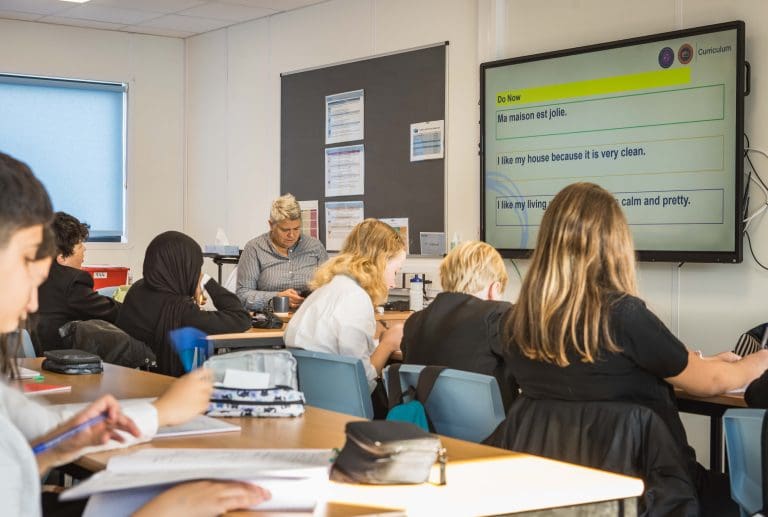
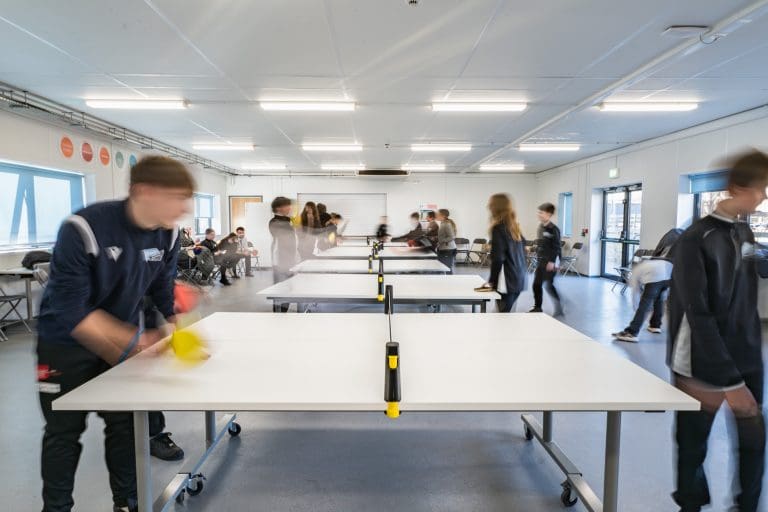
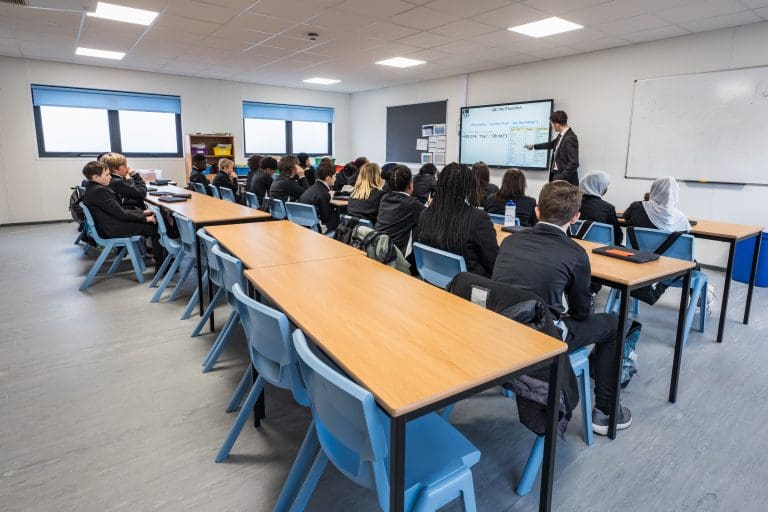
Delivered using McAvoy’s SmartClass® rental solution, the first phase of Oasis Academy Temple Quarter took place in 2023, providing a secure and welcoming temporary school environment for staff and pupils. The ground floor included high-quality facilities such as general classrooms, an art studio, a science laboratory with prep areas, restrooms, an accessible shower room, storage, staff social and work areas, offices, and a dining hall for 180 pupils. A fully equipped servery and linked specialist kitchen unit were also installed, along with internal staircases, lobbies, and circulation spaces.
The wider site was redeveloped to prioritise safeguarding and accessibility, with a secure perimeter boundary, carefully planned emergency access routes, and safe travel arrangements including a student drop-off zone, staff car park, and pedestrian safety improvements at the school entrance.
Phase 2 – First Floor
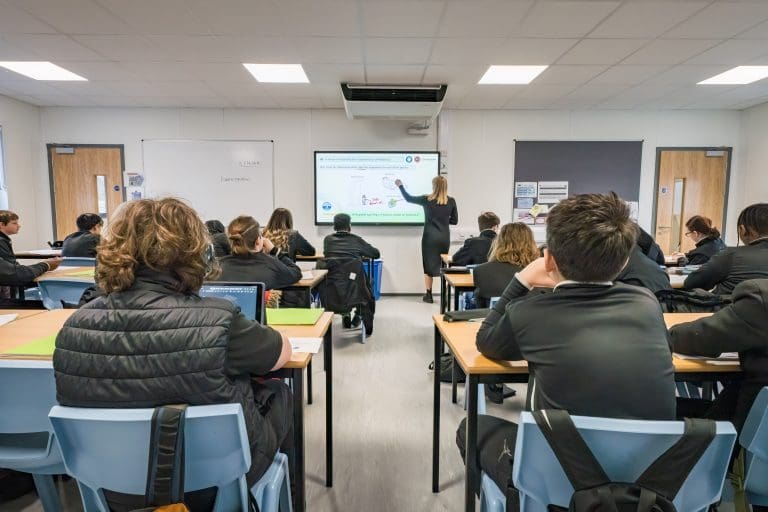
During the 2024 summer break, McAvoy returned to install a second storey, providing additional teaching and staff accommodation. This phase delivered new classrooms, toilet facilities, storerooms, a sick bay, offices, and workrooms. The works were completed within the six-week holiday period, ensuring zero disruption to learning.
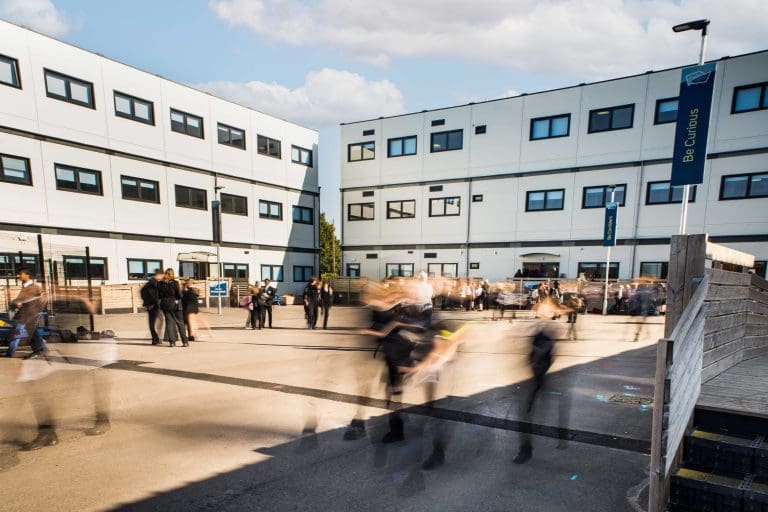
The area around the school was further enhanced with resurfaced car parks, new playgrounds, and a Multi-Use Games Area (MUGA). To support biodiversity, McAvoy installed relocatable planters designed to deliver a Biodiversity Net Gain, which can be reused at other schools within the Trust at the end of the rental period.
Phase 3 – Third Floor and Dining Extension
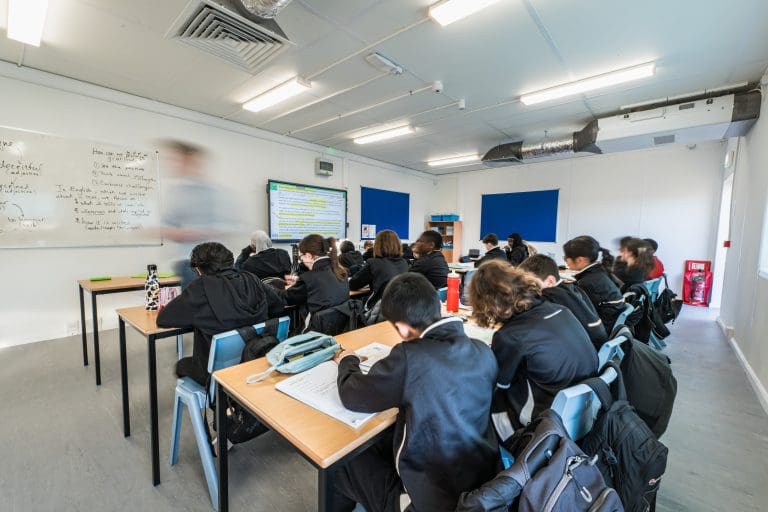
The most recent expansion was completed in summer 2025, this phase added a third storey to the existing modular school and a single-storey dining hall extension. These additional facilities provided much-needed high-quality teaching and social spaces to accommodate the growing pupil intake for the 2025/26 academic year.
In line with the Department for Education’s ‘Be Lean, Be Clean, Be Green’ energy hierarchy, the expansion incorporated energy-efficient lighting, natural ventilation, and waste reduction methods. Once again, all works were delivered within the summer holiday period to minimise disruption and ensure pupils and staff returned in September to an enhanced learning environment.
Looking Ahead – Phase 4
McAvoy will return in summer 2026 to deliver the fourth phase of development: a brand-new three-storey building. This will include upgraded cooking and kitchen facilities, specialist technology rooms for GCSE students, and a full substation upgrade. The next stage will continue to enhance the temporary campus while the Academy awaits its permanent home, ensuring it evolves in line with the needs of its growing school community.
Social Value
McAvoy’s commitment to delivering positive social value outcomes has been integral to this project. The team donated 60 metres of surplus panelling to support a Bristol homeless initiative, along with kitchen equipment including a microwave and kettle. In addition, McAvoy provided funding to the school, enabling them to purchase bicycles for pupils. These contributions reflect McAvoy’s wider commitment to making a lasting difference to the communities it serves.
Sustainability
The temporary school has been designed in line with the DfE’s ‘Be Lean, Be Clean, Be Green’ hierarchy.
Sustainability was at the forefront of the planning and design process with the scheme being required to exceed Building Regulations Part-L (2021), meeting Bristol City Council’s BCS14 policy to achieve a 20% betterment regarding CO2 emissions and energy usage.
1. Be Lean
- High specification glazing to provide optimum natural daylighting and restrict the solar gain to limit overheating.
- Building fabric has been designed to be thermally efficient to be as lean as possible in terms of emission rate. The utilised values are an improvement on the Approved Document Part L 2021
requirements. - Air permeability value utilised is an improvement on the Approved Document Part L 2021 requirements.
- High-efficiency LED lighting throughout.
- High-efficiency heat pump DX split unit systems providing heating and ‘peak temperature lopping’ when required.
- Point-of-use electric water heaters to limit standing losses.
- Natural ventilation and hybrid ventilation are used in preference to mechanical ventilation (where possible) and in compliance with BB101 (2018) regarding overheating and internal CO2 levels.
- All mechanical fans have SFP’s in compliance with the Approved Document Part L 2021 requirements.
- PIR’s installed to operate toilet areas etc, to ensure that they are not in operation when not in use/ required.
- CO2/temperature sensors to operate hybrid ventilation units.
- Metering in line with the requirements of the Building Regulations and utilising the DfE iSERV system.
2. Be Clean
There are no existing district heating systems in the locality of the school buildings and as the school is stand-alone and temporary, there is no requirement for an energy centre.
3. Be Green
170m2 of PV installed over the past 3 years was included in the design to save energy, reduce building emissions, create green on-site energy and ensure compliance with Approved Document Part L 2021 and the Bristol City Council requirements.
Key challenges and solutions
Phase 1
The first phase required a major planning application with strict programme constraints. The site, a disused industrial area, demanded significant preparatory work, including the demolition of derelict buildings and the safe removal of asbestos. Ecological surveys were completed prior to demolition to ensure no disruption to bat habitats.
A key challenge was the identified flood risk in the area. To address this, McAvoy’s design team incorporated raised buildings and walkways into the plans, safeguarding staff and pupils while maintaining safe emergency access.
Ground investigations initially suggested an intrusive 8-metre piled foundation, which would have generated contaminated waste and caused major disruption for residents. Working in close collaboration with engineers and the supply chain, McAvoy instead designed and implemented a reusable surface-mounted temporary foundation system. This innovative approach removed
the need for piling, delivering cost savings, programme certainty, and a strong sustainability outcome.
Phase 2
The second phase brought its own planning requirements and site challenges. To accommodate the school’s growing intake, additional teaching and staff accommodation were installed on a new storey above the existing structure.
This was made possible through the adaptability of McAvoy’s SmartClass® system, which meant the existing roof could be removed and new modules craned in and fitted out. This ensured the school could expand upwards without disruption to learning or the need for a larger footprint on site.
Phase 3
The third phase required another planning application to deliver a further storey of classrooms and a single-storey dining extension. The main challenge was meeting the demand for both teaching and social space in time for the new academic year.
Again, McAvoy’s SmartClass® system demonstrated its flexibility: modules were seamlessly added to the existing structure, and the dining extension was integrated to serve the growing pupil population. The use off offsite manufacturing was crucial to ensuring works could be completed during the summer holiday period, allowing students and staff to return in September to enhanced facilities with no disruption to the academic calendar.
The client perspective
“The temporary school facility and ongoing expansion works has proven to be a highly effective solution for Oasis Academy Temple Quarter as we strive to ensure pupils have the best facilities
and teaching can continue. We are really pleased with how the team at McAvoy have been able to quickly and efficiently navigate our continued expansion needs around our teaching
and learning requirements.” – Richard James, Head of School at Oasis Academy Temple Quarter
“The support from McAvoy has made a real difference to our ongoing work. The fencing looks amazing and is already making a real difference to our site. We really appreciate how helpful
McAvoy have been throughout the process, your generosity and support mean a great deal to us and to the people we work with.” – Maz Andrews, Project Coordinator, Help Bristol Homeless Project Office – Spring Street