
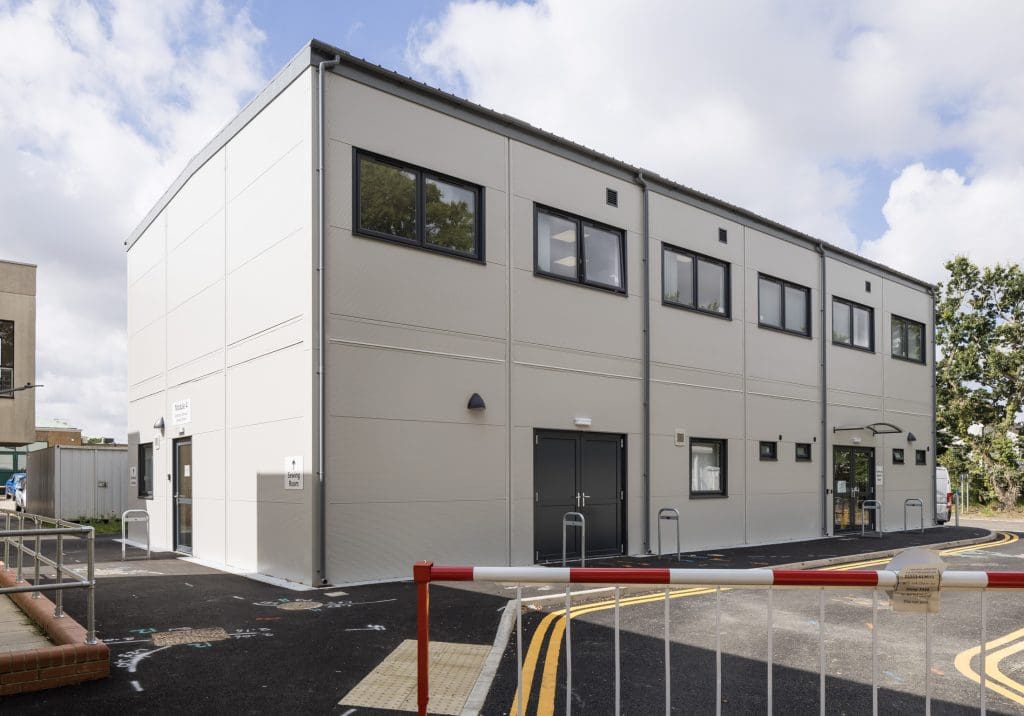
What is a Modular Building & Why Use it?
Modular buildings are reshaping the way we design, construct and deliver spaces. But what is a modular building exactly, and why should sectors such as health, education and commercial consider it?
Simply put, a modular building involves creating sections of a building – known as modules – in a factory-controlled environment, which are then transported to site and assembled. This method of construction offers significant benefits in terms of speed, quality, cost certainty, and sustainability.
If you’re looking to define modular or searching for a clear definition of modular construction, it can be summed up as an efficient, adaptable way to create permanent or temporary buildings using precision-engineered, offsite-manufactured components.
Why Choose Modular Building?
There are many reasons to consider modular construction. Firstly, it allows for much faster project delivery. Modules are manufactured offsite while groundworks take place onsite, meaning projects can often be completed in around half the time of a traditional build. This is critical for sectors under pressure to deliver new facilities quickly, such as education and healthcare.
Secondly, modular buildings are cost-effective. By using offsite manufacturing processes, we can safeguard consistent quality and reduce the likelihood of onsite delays – offering greater budget and programme certainty.
Another key advantage is sustainability. Offsite construction methods produce less waste, use materials more efficiently, and have a smaller environmental footprint. McAvoy’s modular solutions are designed with energy efficiency in mind, supporting better thermal performance and lower running costs.
Whether you’re asking ‘what is a modular building’ or looking for a flexible space solution, modular construction offers solutions that are future-ready, adaptable, and designed for long-term use.
Modular Solutions for Every Need
At McAvoy, our modular space solutions meet a wide variety of temporary and permanent needs, ensuring people can thrive in high-quality environments.
SmartSpace® Modular Fleet
Our SmartSpace® modular fleet, available for rental and sale, brings together design versatility, superior thermal performance, and industry-leading fire ratings. These buildings can be delivered quickly to meet urgent needs, such as classroom shortages, emergency health facilities, or office expansions – without the need for large capital investments.
Key features of SmartSpace® include:
- Stackable up to three storeys
- A2 non-combustible cladding, insulation and roofing
- Ceiling heights ranging from 2.7m to 3m
- Compatible, interchangeable module sizes
- Superior air tightness and U-values exceeding current regulations
SmartSpace® is designed with sustainability in mind and meets, and often exceeds, future building regulation requirements.
QSpace: Immediate Single Modular Building Solution
For customers who need additional space quickly, our QSpace single modular building (SMB) solution is ideal. Available in three different sizes and installable ready to use in just one day, QSpace offers flexibility to meet immediate needs across sectors like education, health and commercial.
QSpace modular buildings are:
- Stackable up to two storeys
- Spacious and adaptable
- Designed for superior energy efficiency
- Built to high standards with product and structural warranties
QSpace enables rapid deployment of inspiring spaces, ensuring minimum disruption and maximum impact.
ESpace: Flexible, High-Quality Modular Solutions
Similarly, ESpace provides a versatile working environment for a range of applications. Available in three sizes, ESpace can be installed within one day, offering spacious, open-plan interiors tailored to your requirements.
With excellent U-values, energy efficiency, and enhanced finishes, ESpace is a smart, sustainable alternative to traditional site-built structures.
Permanent Modular Buildings
Permanent modular buildings are an ideal choice for clients seeking bespoke, high-performance spaces. From concept to completion, McAvoy offers a full design and build solution, ensuring that the end result meets specific requirements.
By choosing permanent modular construction, you benefit from:
- Shorter programmes – typically half the time of a traditional build
- Greater certainty over whole-life costs and performance
- Reduced disruption to neighbouring areas during construction
- High-quality, energy-efficient spaces designed for long-term use
Case Study: Orsett Heath Academy
A prime example of modular buildings in practice is the Orsett Heath Academy in Essex. After the original contractor went into administration, McAvoy stepped in to deliver a three-storey, 8,610m² school for 1,200 pupils. All 209 modules were manufactured offsite and installed within just 13 weeks. This fast-tracked project meant that the school was operational by September 2024, incorporating high-quality classrooms, a performing arts hub, and collaborative breakout spaces.
FAQs: What is Modular?
What is modular?
Modular refers to a method of construction where buildings are made up of individual sections, or modules, which are manufactured in a factory setting and then assembled on-site. Modular construction offers faster delivery times, enhanced quality control, and greater flexibility compared to traditional building methods.
What is a modular building?
A modular building is a structure made from prefabricated modules that are produced offsite and assembled onsite. These buildings can be temporary or permanent, single-storey or multi-storey, and are used across a range of sectors including education, healthcare, and commercial spaces.
How is modular different from traditional construction?
Unlike traditional construction, where much of the building is created onsite, modular construction happens primarily in a factory environment. This reduces weather delays, improves quality consistency, and results in faster project completion times.
Are modular buildings sustainable?
Yes, modular buildings are widely recognised as a more sustainable method of construction. It minimises waste, reduces onsite disruption, and typically incorporates energy-efficient materials and systems.