
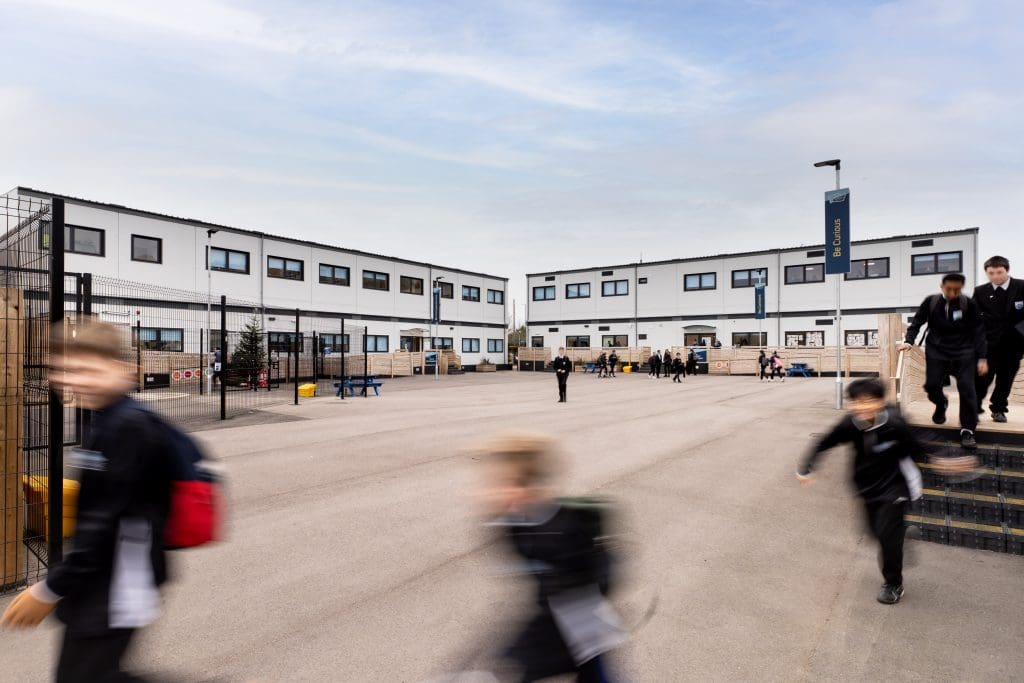
Rethinking Prefab
Once associated with temporary or low-quality structures, prefab has evolved significantly. Today’s modular buildings offer a robust, long-term alternative to traditional construction, combining the speed and efficiency of prefabrication with the quality and flexibility demanded by sectors such as education, healthcare, and commercial development.
In fact, when people talk about prefab multi storey buildings today, what they often need is a modular building. Precision-engineered, energy-efficient, and designed for long-term use.
What’s the difference between prefab and modular?
Prefab is a broad term that refers to any building constructed offsite in advance, usually in standard sections. Modular buildings are a type of prefab, but they go further.
Modular construction involves high-performance modules manufactured in controlled factory conditions, then assembled onsite with minimal disruption. Unlike some older prefab methods, modern modular buildings meet or exceed traditional construction standards and are built to last.
Key Considerations for Prefab Multi Storey Buildings
1. Site conditions and planning
Every successful project starts with a full understanding of the site. With modular buildings, factors like access, ground conditions and local planning regulations need to be carefully considered. McAvoy supports clients from day one, using digital tools to ensure smooth delivery.
Our offsite methods are ideally suited to constrained or urban sites where disruption needs to be minimised and speed is essential.
2. Structural strength and design flexibility
Unlike prefab buildings, modular buildings are designed to be both robust and bespoke.
McAvoy’s SmartSpace® modular systems deliver:
- High-performance structural integrity
- Customisable layouts to suit end-user needs
- Rental and sale options including a 90-minute plus fire rating floor to floor and a 60-minute plus fire rating inside to outside, as well as A2 non-combustible cladding, insulation, and roofing.
Whether it’s to cope with classroom shortages, emergency health requirements or office expansions, modular construction provides certainty and control from design through to installation.
3. Sustainability and circular design
Sustainability is one of the strongest arguments for choosing modular over traditional or outdated prefab methods.
At McAvoy, we follow a circular construction model that maximises reuse, minimises waste, and ensures our buildings meet the highest energy efficiency standards. Key benefits include:
- Up to 70% less energy use during construction
- Minimal material waste due to factory precision
- Use of low-carbon and recyclable materials
- Fully reusable and recyclable modules
We’re also certified to the international BIM ISO 19650-2:2018 standard, supporting data-led, future-ready delivery.
4. Faster delivery, less disruption
Modular prefab multi-storey buildings can be delivered up to 50% faster than conventional builds. That’s because site works and factory manufacturing happen in parallel, reducing project timelines significantly.
This is particularly useful for schools, healthcare providers or commercial sites that need to stay operational during expansion. For example, our phased delivery at Oasis Academy Temple Quarter was timed around term dates to avoid disruption entirely.
5. Value for money and long-term performance
Modular construction isn’t just faster, it’s also more cost-effective. Prefab multi-storey buildings built using modern modular techniques benefit from:
- Reduced labour costs
- Predictable, fixed pricing
- Lower operating costs over the building’s lifetime
And because McAvoy builds for longevity, clients can rely on their buildings to perform well for decades.
Case Study: Modular Expansion at Oasis Academy Temple Quarter
This multi-phase project highlights how modular can outperform traditional prefab approaches.
Project overview:
- Phase 1 (2023): Ground floor classrooms and support spaces
- Phase 2 (2024): First-storey modular units added
- Phase 3 (2025): Second-storey expansion in line with student growth
Why modular worked:
- Flexible phased delivery strategy
- Minimal disruption to students and staff
- High-quality finishes with fast installation
FAQs
Are prefab multi storey buildings the same as modular buildings?
Not exactly. Modular buildings are a specific type of prefab, but they use advanced design and engineering techniques to deliver better performance, higher quality and greater sustainability.
How quickly can a building be delivered?
Using modular construction, McAvoy can deliver a 2 or 3 storey building in around half the time of traditional methods, depending on scope and planning.
Are modular buildings built to last?
Yes. Permanent modular buildings are engineered for long-term use, and can exceed the quality of traditional builds.
What makes modular more sustainable than traditional prefab?
- Up to 70% less energy used
- Reduced carbon footprint
- Smarter material use and less waste
Why McAvoy?
McAvoy is a market leader in modern prefab and modular multi storey buildings across the UK and Ireland. Whether you need a fast-track classroom block, a modular healthcare facility or a long-term commercial building, we’ll deliver a solution that combines speed, sustainability, and performance.